
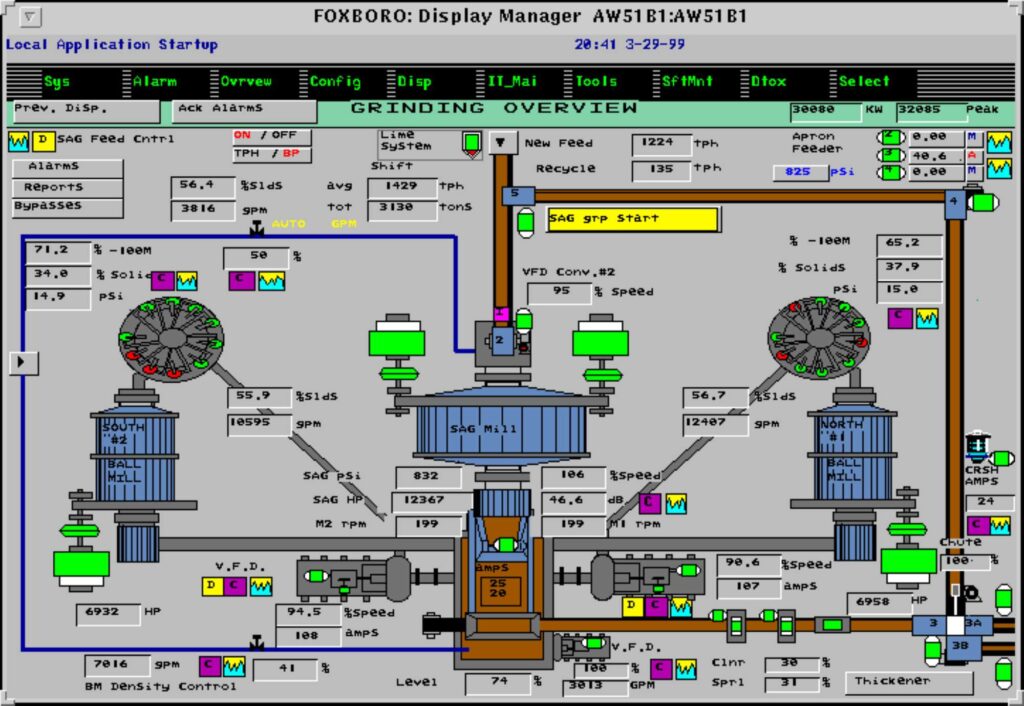

Introduction
Foxboro, a brand under Invensys (later Schneider Electric), developed the I/A Series control system as one of the first truly open industrial automation platforms. Version 6 of this system represented a significant evolution, combining robust hardware with advanced software tools to meet the growing demands of process industries such as oil refining, petrochemicals, and power generation.
⚙️ Key Features of Foxboro I/A Series Version 6
- Distributed Architecture
- Truly distributed control system (DCS) with nodes spread across local and wide area networks.
- Allowed scalability from small plants to large, complex industrial sites.
- Flexible Hardware & Software Modules
- Mix-and-match modules for logic control, operator interface, and process automation.
- Backward compatibility ensured older investments were preserved.
- Control Software Configuration Tools
- Graphical construction of control strategies.
- Reusable component and composite designs for efficiency.
- Live updates of real-time values directly on control diagrams.
- Bulk generation and migration of strategies from templates or existing systems.
- Advanced Controller Functions
- Support for PID and advanced control blocks with mathematical modeling.
- Engineers could tune controllers using Laplace-transformed equations for optimal performance.
- Open System Standards
- Adherence to international communication and software standards.
- Integration with third-party applications and interoperability with other systems.
- Operator Interface
- High-resolution graphics and multiple windows for secure, user-friendly interaction.
- Real-time monitoring and reporting capabilities.
- Fieldbus & Device Integration
- Support for FOUNDATION™ Fieldbus and PROFIBUS intelligent devices.
- Simplified configuration of field networks.
📊 Benefits of Version 6
| Feature | Benefit |
| Distributed architecture | Scalability and reliability across large plants |
| Graphical configuration tools | Faster engineering and reduced errors |
| Backward compatibility | Preserved prior investments |
| Open standards | Easy integration with third-party systems |
| Advanced controller functions | Improved process stability and efficiency |
| Fieldbus support | Seamless device communication |
🌍 Legacy and Impact
Foxboro Version 6 was not just a control system—it was a foundation for modern automation. By combining flexibility, openness, and powerful engineering tools, it enabled industries to:
- Reduce costs of installation and maintenance.
- Improve productivity through better control strategies.
- Prepare for future expansions with scalable architecture.
Even though newer versions have since replaced it, Version 6 remains a landmark in industrial automation history, remembered for its reliability and adaptability in critical industries.
✅ In summary, Foxboro I/A Series Version 6 provided a robust, flexible, and open control system with advanced configuration tools, distributed architecture, and strong integration capabilities. It set the stage for future generations of industrial automation systems.
Sources:
Would you like me to also compare Version 6 with later versions (like v8 or v9) so you can see how the system evolved? That could highlight what made v6 unique versus modern upgrades.