
ntroduction
Oracle Forms 6i was a cornerstone of enterprise application development during the late 1990s and early 2000s. As part of the Oracle Developer Suite, it enabled developers to create robust, data-driven applications using a graphical interface and tight integration with Oracle databases. Though now considered legacy software, Forms 6i played a vital role in shaping modern business systems and remains in use in some long-standing environments.
Overview of Oracle Forms 6i
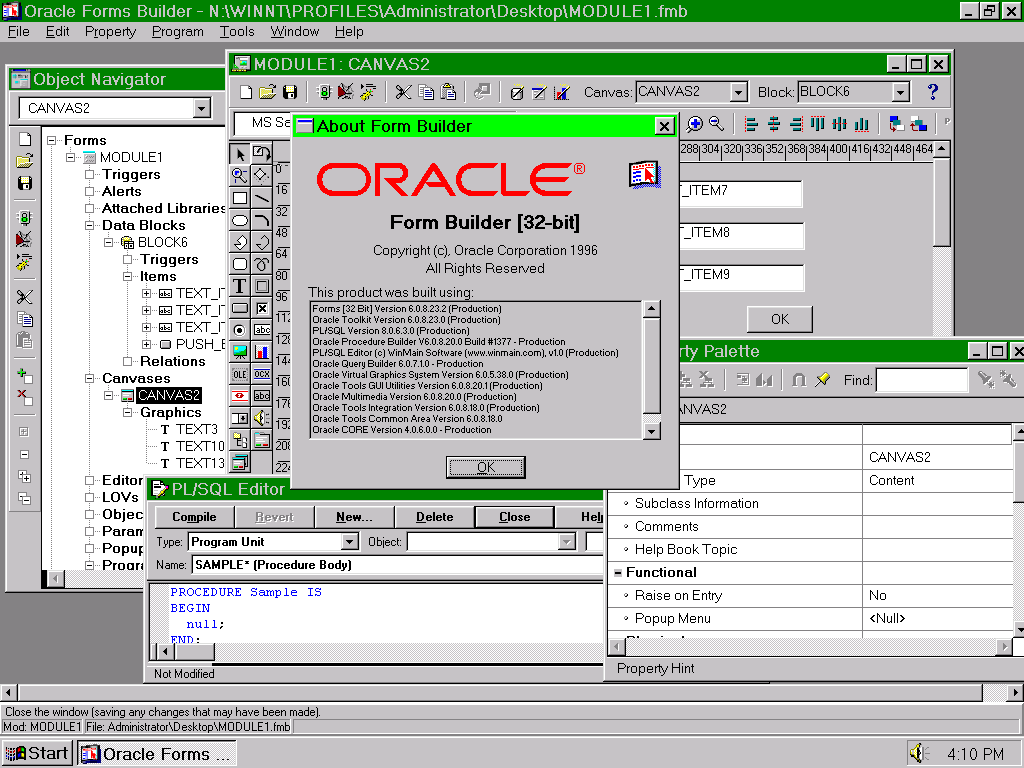
Oracle Forms 6i is a GUI-based development environment for building applications that interact with Oracle databases. It supports client-server architecture, allowing applications to run on desktop clients while connecting to centralized databases.
Key Features:
- PL/SQL Integration: Developers could write triggers, procedures, and functions directly within the form.
- Object-Oriented Design: Forms were built using blocks, canvases, windows, and items, promoting modular design.
- Built-in Wizards: Simplified the creation of forms, reports, and menus.
- Multi-platform Support: Ran on Windows, UNIX, and Solaris systems.
- Forms Runtime: Allowed compiled forms to be executed in production environments.
Development Workflow
Oracle Forms 6i used a module-based structure:
- Form Modules: Contained user interface and logic.
- Menu Modules: Defined navigation and access control.
- Library Modules: Shared code across multiple forms.
- PL/SQL Units: Embedded business logic and database interaction.
Developers used the Layout Editor to design canvases and windows, placing items like text boxes, buttons, and lists. Triggers were attached to events (e.g., WHEN-BUTTON-PRESSED) to define behavior.
Use Cases and Applications
Forms 6i was widely used in:
- ERP Systems: Custom modules for finance, HR, and inventory.
- Government and Education: Student records, payroll, and citizen services.
- Manufacturing and Logistics: Real-time data entry and reporting.
Its tight coupling with Oracle databases made it ideal for transactional systems requiring high reliability and data integrity.
Limitations and Legacy Challenges
Despite its strengths, Forms 6i has several limitations:
- Client-server dependency: Required local installations and network configuration.
- Limited web support: Early attempts at web deployment were complex and fragile.
- Outdated UI: Interfaces lacked modern design and responsiveness.
- End of support: Oracle has discontinued support, urging migration to newer platforms.
Migration to Modern Platforms
Organizations still using Forms 6i are encouraged to migrate to:
- Oracle Forms 12c: Offers web deployment, REST integration, and cloud readiness.
- Oracle APEX or Java: For full web-native development.
- Modern frameworks: Like Angular, React, or .NET for scalable, responsive apps.
Migration involves:
- Analyzing existing forms and logic
- Rewriting or converting modules
- Testing and validating business rules
- Training developers on new platforms
Conclusion
Oracle Forms 6i was a pioneering tool that empowered developers to build complex, data-centric applications with speed and reliability. While its architecture is now outdated, its legacy lives on in many enterprise systems. Migrating to modern platforms ensures continued innovation, security, and scalability for future business needs.
Would you like a migration checklist or a comparison between Forms 6i and Oracle APEX or Forms 12c? I can also help you simulate a migration plan for your refinery systems.
Sources: Oracle Forms 6i Documentation, YSU Training Workbook.